Agave Health
Client
Design & Development
Client
Design & Development
Client
Design & Development
Year
2025
Year
2025
Year
2025
Services
Agave Health is a digital platform for mental health management that connects users with licensed therapists. It offers individual and group therapy sessions, as well as self-learning resources. Users can schedule sessions, track their progress, and receive support through an intuitive interface. Agave Health aims to make mental health services more accessible and personalized.
Services
Agave Health is a digital platform for mental health management that connects users with licensed therapists. It offers individual and group therapy sessions, as well as self-learning resources. Users can schedule sessions, track their progress, and receive support through an intuitive interface. Agave Health aims to make mental health services more accessible and personalized.
Services
Agave Health is a digital platform for mental health management that connects users with licensed therapists. It offers individual and group therapy sessions, as well as self-learning resources. Users can schedule sessions, track their progress, and receive support through an intuitive interface. Agave Health aims to make mental health services more accessible and personalized.
Project Steps
Our project developed in two stages. The first was the MVP phase, designed to test how users interact with our form. The second focused on refining the product for actual use.
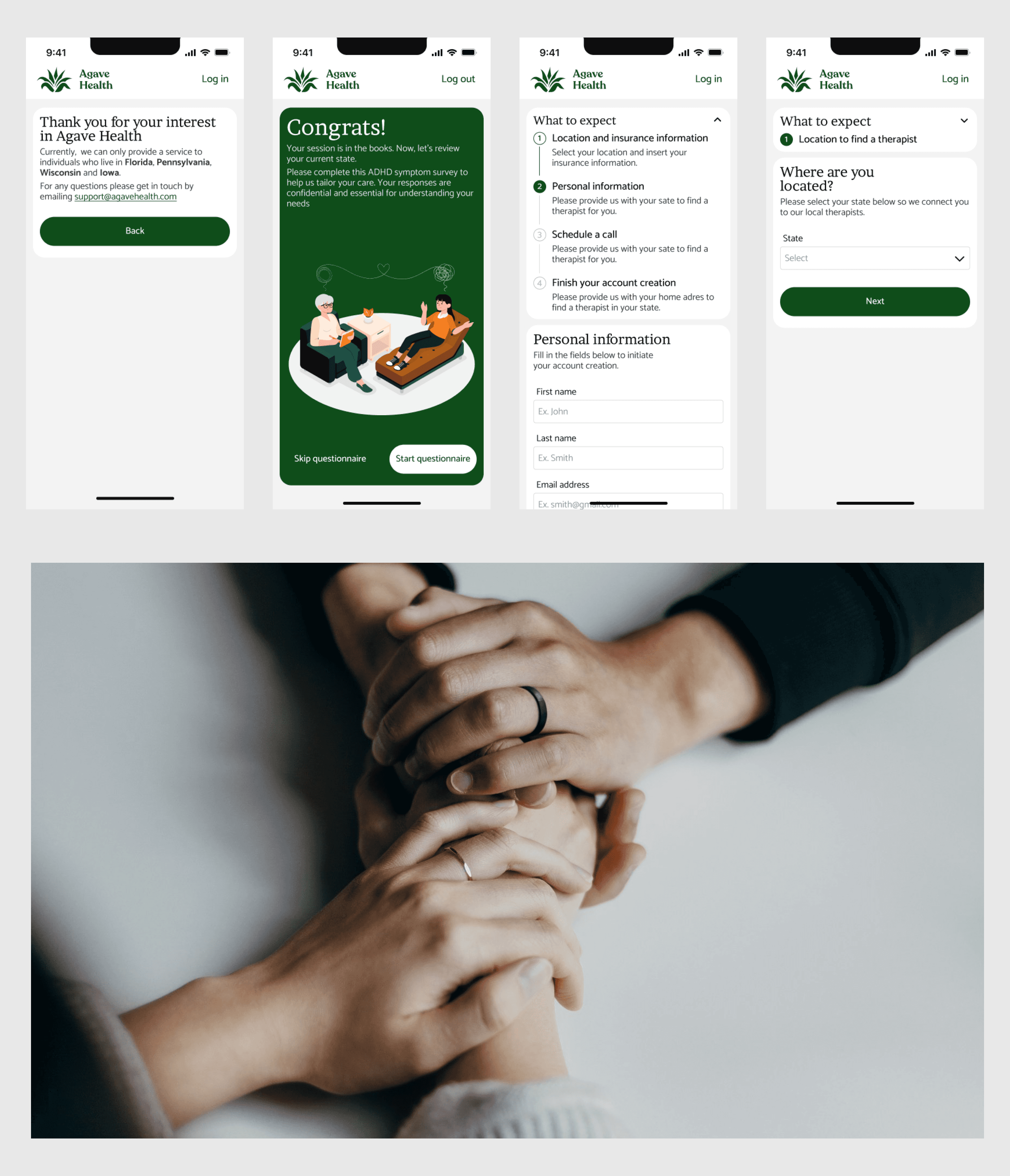
We started with research, where I worked with the product manager to analyze competitors, interview our target audience, and consult psychotherapists. Next, we built the information architecture, defining essential data and eliminating unnecessary fields to streamline the process.
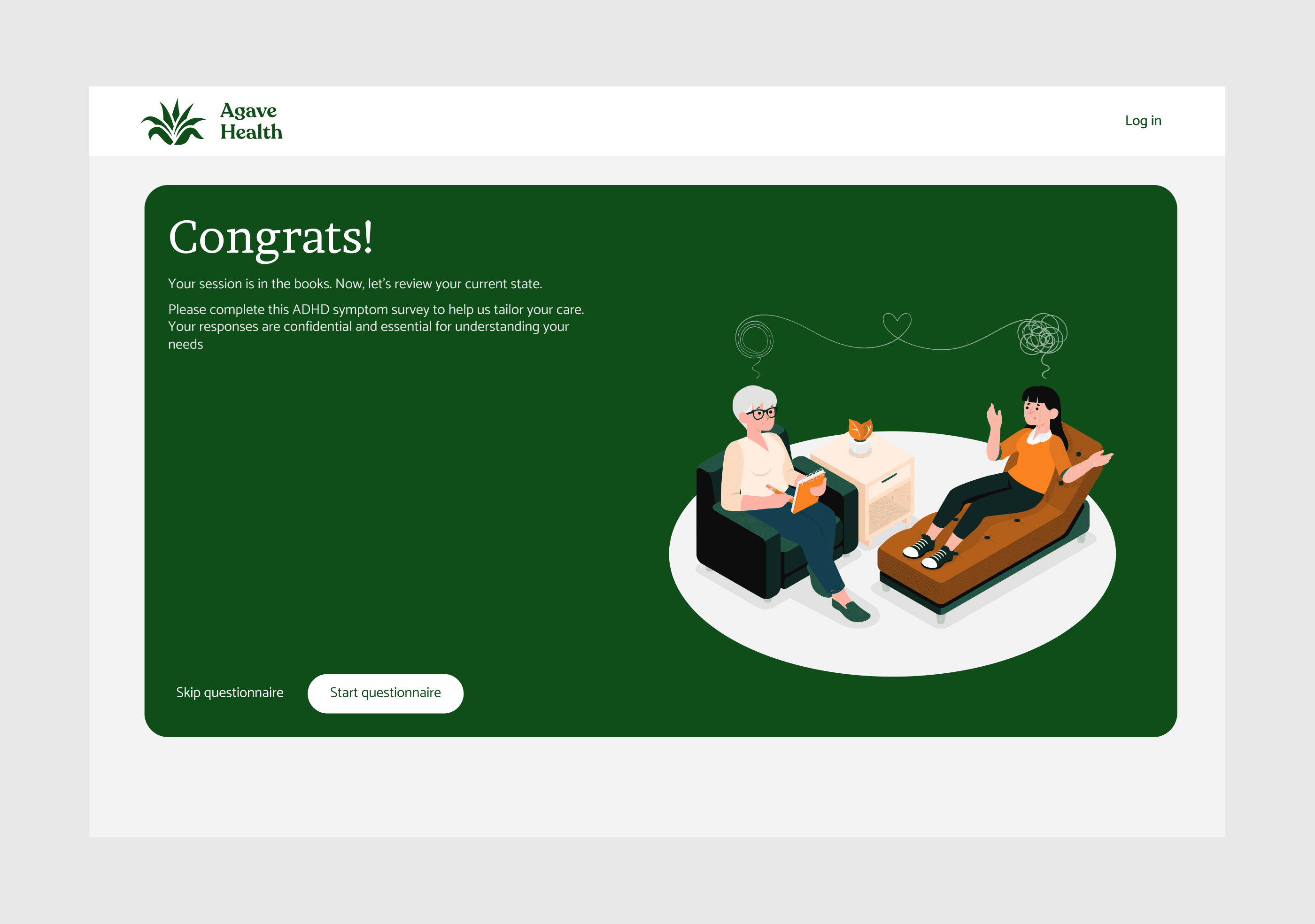
Then, I designed the user flow through wireframes, which we tested with our audience. After that, I created two visual design concepts, and we chose a minimalist style using deep green while removing orange, as it was too distracting.
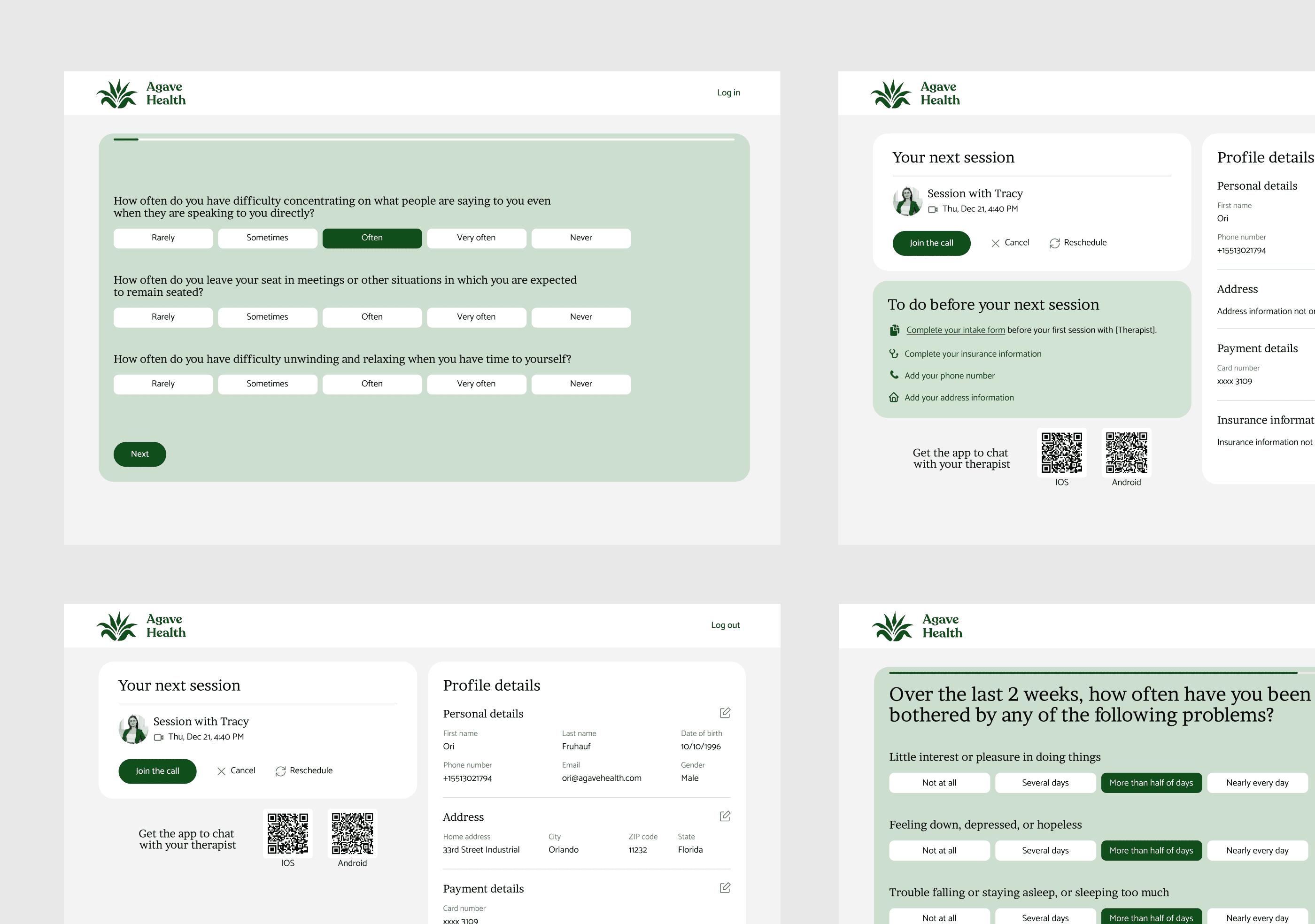
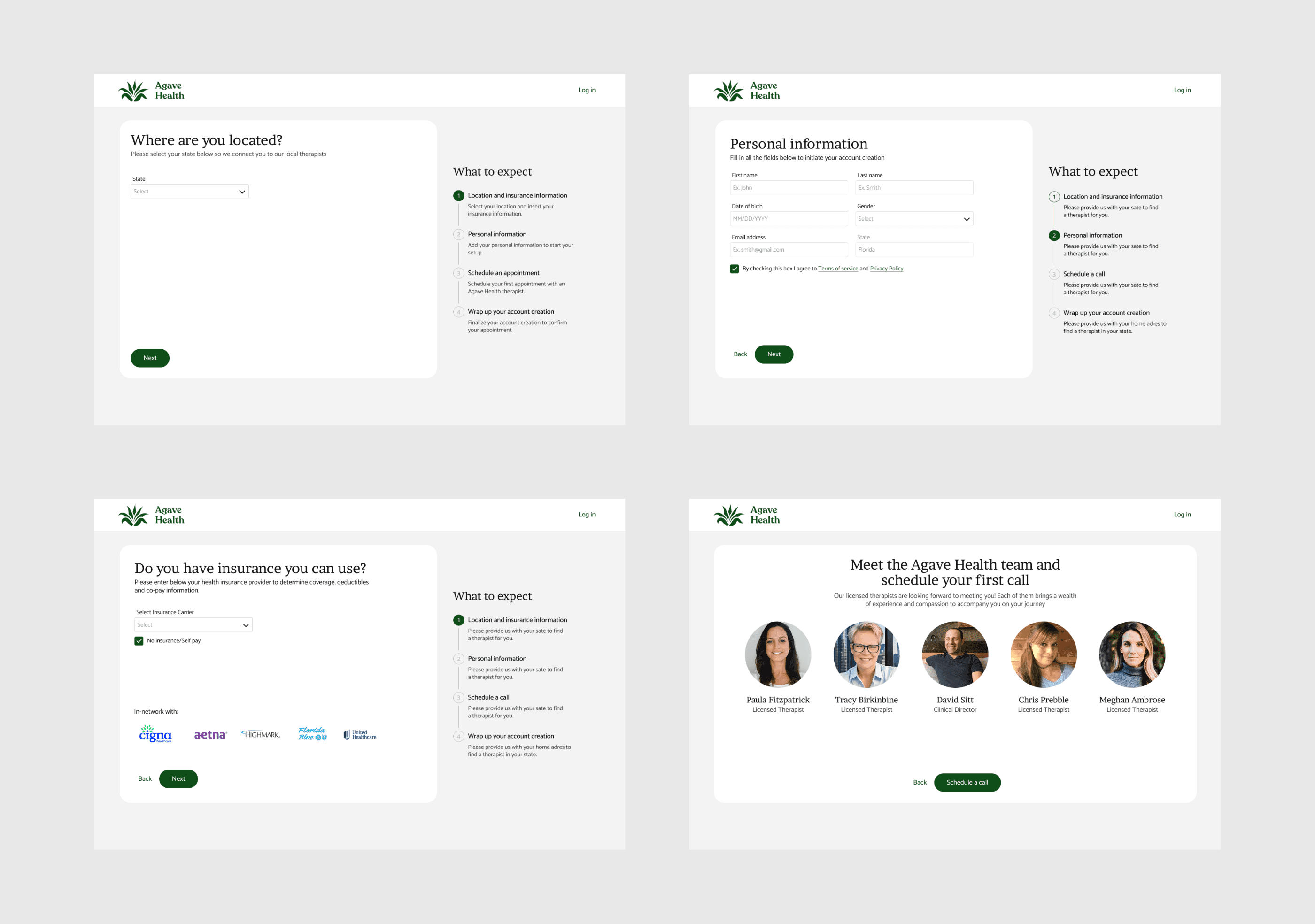
The final stage was testing. Over two weeks, we identified pain points—users struggled to complete the flow. To improve this, I simplified the process and added UX elements to aid users with ADHD, such as a progress indicator showing how much remained to complete.
Our project developed in two stages. The first was the MVP phase, designed to test how users interact with our form. The second focused on refining the product for actual use.
We started with research, where I worked with the product manager to analyze competitors, interview our target audience, and consult psychotherapists. Next, we built the information architecture, defining essential data and eliminating unnecessary fields to streamline the process.
Then, I designed the user flow through wireframes, which we tested with our audience. After that, I created two visual design concepts, and we chose a minimalist style using deep green while removing orange, as it was too distracting.
The final stage was testing. Over two weeks, we identified pain points—users struggled to complete the flow. To improve this, I simplified the process and added UX elements to aid users with ADHD, such as a progress indicator showing how much remained to complete.
Our project developed in two stages. The first was the MVP phase, designed to test how users interact with our form. The second focused on refining the product for actual use.
We started with research, where I worked with the product manager to analyze competitors, interview our target audience, and consult psychotherapists. Next, we built the information architecture, defining essential data and eliminating unnecessary fields to streamline the process.
Then, I designed the user flow through wireframes, which we tested with our audience. After that, I created two visual design concepts, and we chose a minimalist style using deep green while removing orange, as it was too distracting.
The final stage was testing. Over two weeks, we identified pain points—users struggled to complete the flow. To improve this, I simplified the process and added UX elements to aid users with ADHD, such as a progress indicator showing how much remained to complete.
About
the Process
When I joined Agave Health, the platform was a mobile app focused on coaching and chat-based support. My main task was to develop a web platform for online therapy, introducing a new system for working with licensed therapists. A key challenge was designing a user registration flow that would successfully guide users to their first therapy session. To achieve this, I conducted research on how people with ADHD process online information, consulting with therapists for insights. I also analyzed competitors’ platforms to identify best practices. Initially, the platform only offered a simple booking window for therapy sessions. My role was to enhance this by adding a structured intake questionnaire to collect user data, including medical history, insurance details, and payment information. After launching the MVP, we realized the form was too long. Based on expert recommendations, I streamlined the questionnaire, reduced the number of steps, and introduced a progress bar to improve user experience. These changes led to a significant increase in conversion rates. In the first week, only 2 out of 38 users completed the process, after optimizations, 12 out of 56 reached the final step within a week.
When I joined Agave Health, the platform was a mobile app focused on coaching and chat-based support. My main task was to develop a web platform for online therapy, introducing a new system for working with licensed therapists. A key challenge was designing a user registration flow that would successfully guide users to their first therapy session. To achieve this, I conducted research on how people with ADHD process online information, consulting with therapists for insights. I also analyzed competitors’ platforms to identify best practices. Initially, the platform only offered a simple booking window for therapy sessions. My role was to enhance this by adding a structured intake questionnaire to collect user data, including medical history, insurance details, and payment information. After launching the MVP, we realized the form was too long. Based on expert recommendations, I streamlined the questionnaire, reduced the number of steps, and introduced a progress bar to improve user experience. These changes led to a significant increase in conversion rates. In the first week, only 2 out of 38 users completed the process, after optimizations, 12 out of 56 reached the final step within a week.
When I joined Agave Health, the platform was a mobile app focused on coaching and chat-based support. My main task was to develop a web platform for online therapy, introducing a new system for working with licensed therapists. A key challenge was designing a user registration flow that would successfully guide users to their first therapy session. To achieve this, I conducted research on how people with ADHD process online information, consulting with therapists for insights. I also analyzed competitors’ platforms to identify best practices. Initially, the platform only offered a simple booking window for therapy sessions. My role was to enhance this by adding a structured intake questionnaire to collect user data, including medical history, insurance details, and payment information. After launching the MVP, we realized the form was too long. Based on expert recommendations, I streamlined the questionnaire, reduced the number of steps, and introduced a progress bar to improve user experience. These changes led to a significant increase in conversion rates. In the first week, only 2 out of 38 users completed the process, after optimizations, 12 out of 56 reached the final step within a week.